
3 min read
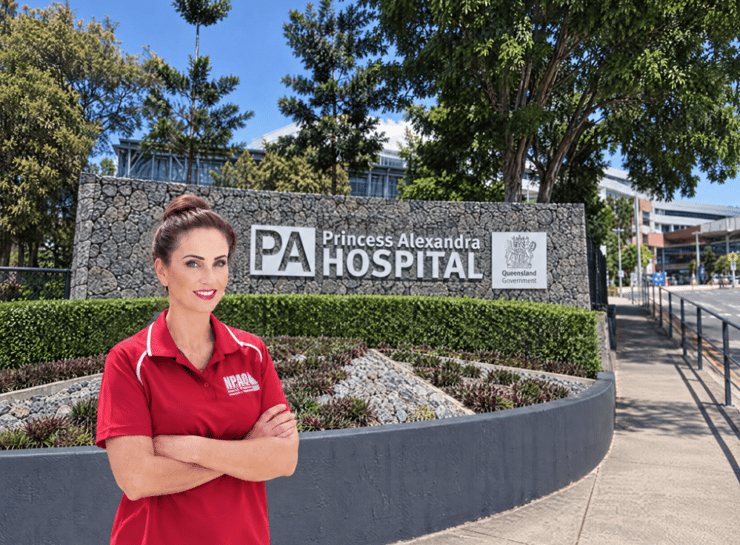
Our members at the Princess Alexandra Hospital have been telling us the same thing. Prisoner patients are being placed in outpatient areas and general wards, sometimes in a room with other patients, guarded by corrective services officers.
The Princess Alexandra Hospital (PAH) has a unit built for exactly this. The PAH Secure Unit (SECU) has twelve beds and is run jointly with Queensland Corrective Services. Twelve beds for the whole of South East Queensland.
In 2017 Metro South said publicly that prisoners attending the PAH are triaged and treated in the Emergency Department and then moved back to the secure facility, and that they would not be waiting in public areas. That is not what our members are describing in 2026.
So we asked them. We ran an anonymous survey of PAH members on where prisoner patients are being placed, what the security arrangements look like, and whether staff have had any training for it. The answers came from nurses across multiple clinical areas.
Read more in The Courier Mail here.
The ICU incident
On August 31 a man in police custody following a stabbing was being treated in the intensive care unit at the PAH, guarded by two Queensland Police officers.
We are informed that he was sedated but repeatedly roused and became aggressive. A clinical decision was made that sedation removed the need for handcuffs, so he was left in soft restraints only. The following day he pulled out his endotracheal tube and lines, got free of the restraints and assaulted one of the officers, coming close to gaining control of her firearm.
That happened in an ICU where two armed police officers were already present. What happens when there are no police there at all?
Three sets of rules
The ICU patient was in police custody. Prisoner patients in outpatient and general wards are guarded by corrective services officers. Forensic patients in authorised mental health services are not guarded by police or Corrective Services officers, because corrective services officers have no jurisdiction there and the job falls to nurses.
Same ward, same nurse, same risk, three different sets of rules.
What we have done
On 26 August we wrote to the Premier and five Ministers with a 21-item reform package on occupational violence, including custodial responsibility and the amendment we want to the Mental Health Act 2016.
Read our 21-item occupational violence reform package here.
Since then we have written jointly to the Health Minister, the Director-General of Queensland Health, Metro South Health, the PAH executive, the Queensland Police Service and Queensland Corrective Services. We have asked each of them, in writing, for the policy that governs where a prisoner patient can be placed, who decides on restraint, and how many prisoner patient presentations the PAH has had in the last 12 months.
What you can do
Report every incident through RiskMan, every time. If your report goes nowhere, tell us.
If you work at the PAH and you have seen a prisoner patient placed in a shared clinical area, email us at hotline@redunion.com.au, or call 1300 263 374. Nothing you tell us is published in a way that identifies you or your ward.
As one member put it to us, zero tolerance is just a poster. The reality is total tolerance. Our nurses are not human shields. We intend to keep saying so until something changes.
Related Posts
Queensland Nurses vs. Government Priorities
Nurses in Queensland Demand Recognition and Fair Treatment
Queensland Premier Steven Miles has told...
Queensland's Hospital System is on the Brink, and Nurses are Paying the Price
Case Win: NPAA Secures Settlement & Protects Nurse's Employment Rights
NPAA Defends Nurses' Professional Standing with Legal Support
When nurses face employment...